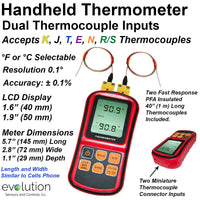


Type C Thermocouples - Items tagged as "Fiberglass-insulated-thermocouple-wire-24-gage-solid-900-f-rating"


What are Type C Thermocouples?
- Type C Thermocouples are made from Tungsten Rhenium alloys and designed for extreme high temperatures up to 4,200°F (2315°C). The thermocouple materials must be utilized in a hydrogen, inert, or vacuum atmospheres to prevent failure from oxidation.
- Maximum Temperature Range is influenced by bare wire diameters, protective sheaths and to small degree the attached connectors or extension wire leads.
-
Bare Wire Diameters - Thermocouple Grade Tungsten-Rhenium
-
.010" (30 Gage) to .020" (24 Gage) 32° to 4200°F (0°C to 2315°C)
- .005" (36 Gage) 32°F to 3600°F (0°C to 1980°C)
- .003" (40 Gage) 32°F to 3400°F (0°C to 1870°C)
-
.010" (30 Gage) to .020" (24 Gage) 32° to 4200°F (0°C to 2315°C)
-
Protective Sheaths, Tubes and Insulators
- Sheaths of Ceramic (Alumina) and Metals (Molybdenum, Tantalum and Inconel)
- Insulators of Alumina, Hafina, and Magnesium Oxide
-
Type C Connectors - Click to View - the pin materials are compensating alloys. The pins are not made from Tungsten-Rhenium materials.
- Thermoplastic body design is rated 400°F (200°C)
- High Temperature Thermoset design 650°F (350°C)
- Ultra High Temperature Thermoset 800°F (425°C) and Intermittent capabilities at 1000°F (540°C)
- Ceramic 1200 °F (650 °C)
-
Type C Thermocouple and Extension Wire - Click to View
- Tungsten-Rhenium thermocouple bare wire, the positive wire 95% tungsten and 5% rhenium and the negative wire consists of 74% tungsten and 26% rhenium.
- Type C Extension Wire is not made from Tungsten-Rhenium thermocouple alloys, it is special made compensating alloys.
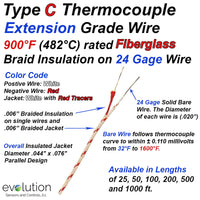
- Insulation on the Type C Extension Wire is FEP or PFA Plastic Fluoropolymer Insulation rated to 400°F (200°C) or 500°F (260°C) along with a wire design made with Fiberglass Braid Insulation rated 900°F (480°C)
- The Extension Grade Wire follows thermocouple curve to within ± 0.110 millivolts from 32°F to 1600°F.
- If the extension wire is exposed to temperatures over 400°F (200°C) the transfer error could be more than 0.100 millivolts tolerance
- Application Industries - include semiconductor processing and equipment, military and defense testing, research, high temperature materials manufacturing, aerospace, power generation and others.
-
Click to view Type C milivolt chart in degrees °C
- Typical Millivolt Output per °C = 0.019. examples at 1000°C = 18.260 mV and at 2000°C = 33.669 mV
Special Offers and Product Education